
7 Top AI Video Tools Transforming Content Creation in 2026
 The reign of video content is undeniable, captivating audiences across social media, educational platforms, and professional marketing landscapes. Yet, crafting compelling video has historically been an uphill battle, demanding a steep learning curve, costly software, and significant time commitment. But what if you could bypass those traditional hurdles? In 2026, the power to create stunning videos is no longer exclusive to seasoned professionals. The emergence of sophisticated AI video tools is democratizing this creative frontier, empowering you to produce polished, professional-grade content with remarkable speed and simplicity. Get ready to discover the 7 top AI video tools that are revolutionizing how you bring your visual stories to life, making effortless and impactful video creation your new reality.
Introduction: The AI Video Revolution is Here
The digital landscape is awash in video, with an insatiable demand for high-quality, engaging content. Traditional video editing, however, remains a bottleneck—time-consuming, skill-intensive, and costly. This is where AI steps in, democratizing video creation and making it accessible to everyone. This year, the emergence of innovative solutions is set to redefine content creation. We will preview some of the top AI video tools transforming the industry in 2026, highlighting a significant shift towards intuitive, conversational, and automated editing processes.
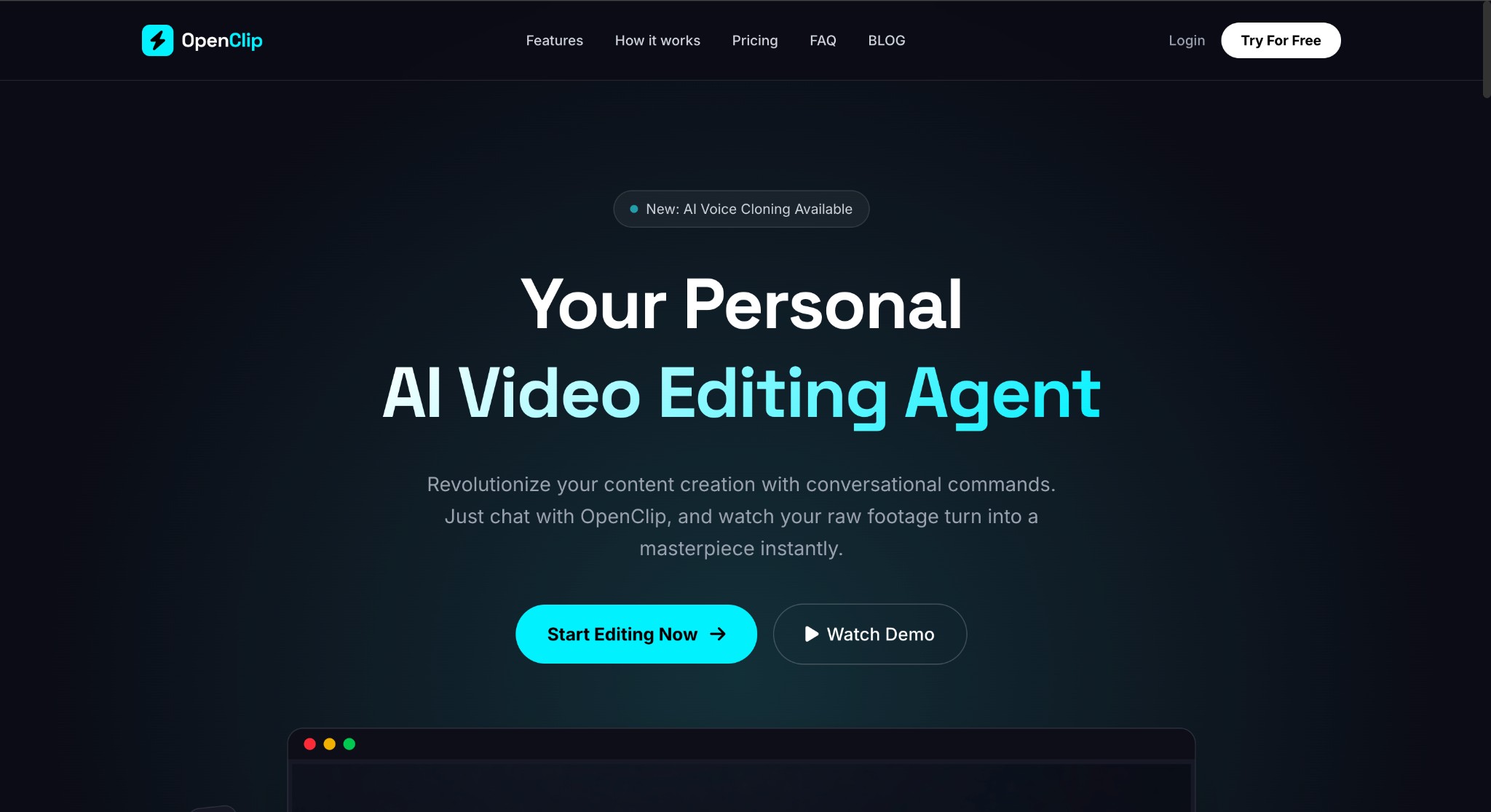
The AI video revolution is here, offering unprecedented ease and power. Tools like DomoAI, Kling AI, Runway, Google Veo 2, OpenAI Sora, Pika 2.2, and Adobe are leading this charge. These platforms are moving beyond basic generation, focusing on sophisticated, automated workflows. For instance, OpenClip, a prime example of a personal AI video editing agent, transforms raw footage into professional videos via simple chat commands. It automatically removes silence, adds captions, and inserts background music and smart transitions instantly. This allows for multi-round revisions without any editing skills, making it the ultimate content creation tool for YouTubers, vloggers, and modern creators. The era of complex timelines and steep learning curves is rapidly fading, replaced by conversational interfaces and intelligent automation.
1. OpenClip: Your Conversational Video Editing Agent
OpenClip emerges as a revolutionary personal AI video editing agent, simplifying the creation of professional-grade videos through intuitive chat commands. It transforms raw footage into polished content, making advanced editing accessible to everyone. As one of the most efficient top AI video tools, OpenClip streamlines the workflow for content creators.
Transforming Raw Footage with Chat Commands
OpenClip's core functionality lies in its ability to translate simple conversational instructions into complex editing actions. Users can describe their desired edits, and the AI agent intelligently manipulates the footage, eliminating the steep learning curve traditionally associated with video editing software. This approach democratizes video production, allowing individuals without prior editing experience to achieve professional results.
Automated Silence Removal and Captioning
Efficiency is paramount with OpenClip. It automatically identifies and removes silent pauses within your footage, ensuring a more dynamic and engaging viewing experience. Furthermore, OpenClip offers instant, AI-generated captions, significantly boosting accessibility and watchability for your videos, a crucial feature for modern content consumption.
Smart Music and Transition Integration
Elevate your videos with OpenClip's intelligent background music and transition insertion. The AI analyzes your footage and content to suggest and seamlessly integrate appropriate music tracks and transitions, enhancing the narrative flow and visual appeal without manual effort.
Effortless Multi-Round Revisions for All Skill Levels
OpenClip champions a user-friendly, iterative editing process. Its multi-round revision capability means you can refine your video through further chat commands, making adjustments and improvements without needing to master complex interfaces. This makes it an ideal solution for beginners and seasoned creators alike.
Ideal for YouTubers, Vloggers, and Modern Creators
For YouTubers, vloggers, and contemporary content creators, OpenClip represents a significant leap in productivity. It drastically reduces editing time, allowing creators to focus on content ideation and audience engagement. By automating tedious tasks like silence removal and captioning, and simplifying complex edits through natural language, OpenClip positions itself as an indispensable tool for efficient and high-quality video production.
2. AI-Powered Script-to-Video Generators: Bringing Ideas to Life
The landscape of video creation is being revolutionized by AI, transforming text-based concepts into dynamic visual narratives. These innovative tools democratize content production, enabling individuals and businesses to rapidly prototype and visualize ideas. By leveraging advanced AI models, script-to-video generators are becoming essential for creators across various domains, making them a key part of exploring the top AI video tools.
From Text to Visuals: The Magic of AI Generation
AI-powered script-to-video generators are at the forefront of this transformation. Tools like those from Runway (Gen 4), Pika 2.2, and OpenAI Sora, alongside emerging platforms like DomoAI, can interpret textual descriptions and translate them into video sequences. This process involves sophisticated AI models that understand context, style, and motion, effectively bridging the gap between imagination and visual reality.
Tools for Conceptualizing and Prototyping Video Ideas
These platforms excel at rapid prototyping. Imagine needing a visual for a marketing campaign or an educational module; instead of lengthy pre-production, you can input a script or prompt and receive an initial video concept within minutes. For instance, OpenClip acts as a personal AI video editing agent, transforming raw footage into professional videos through simple chat commands, automating silence removal, captioning, and music insertion. This allows for multi-round revisions without extensive editing skills, a significant advantage for YouTubers and modern content creators.
Leveraging Advanced AI Models for Creative Output
The underlying technology relies on advanced AI models, including diffusion models and large language models, capable of generating unique visuals and animations from textual input. This allows for a high degree of creative control, enabling the production of diverse content, from realistic scenes to abstract animations.
Use Cases: Marketing, Education, and Personal Projects
The applications are vast. Marketing teams can quickly generate explainer videos or social media ad concepts. Educators can create engaging visual aids for complex topics. For personal projects, hobbyists can bring their stories to life without needing traditional filmmaking expertise. Platforms like Kling AI (2.0) and Google Veo 2 further push the boundaries of what's possible, offering enhanced realism and creative flexibility, solidifying their place among the top AI video tools for diverse creative endeavors.
3. Intelligent Video Editing Suites: Streamlining the Workflow
The landscape of video creation is being revolutionized by intelligent editing suites, transforming how content is produced. These powerful tools leverage AI to automate complex processes, making professional-grade editing accessible to a wider audience. By focusing on efficiency and intelligent suggestions, these platforms are reshaping workflows for both seasoned editors and aspiring creators.
Automating Repetitive Editing Tasks
Tools like OpenClip act as personal AI video editing agents. They streamline the process by handling time-consuming tasks such as automatically removing silence and inserting captions. This frees up creators to focus on the narrative and creative aspects of their videos, significantly reducing the manual effort involved in basic editing.
Smart Content Analysis and Highlight Extraction
A key innovation in modern AI video tools is their ability to analyze raw footage intelligently. Features like smart content analysis allow these suites to identify key moments or extract compelling highlights automatically. This is invaluable for quickly sifting through hours of footage to pinpoint the most engaging segments, a critical step in producing dynamic content for platforms like YouTube and TikTok.
AI for Efficient Clip Selection and Assembly
Beyond simple extraction, AI assists in the crucial task of selecting and assembling the best clips to form a cohesive narrative. Intelligent suggestions for cuts, pacing, and scene arrangement help ensure a polished final product. This capability is a cornerstone of many top AI video tools, enabling creators to build engaging stories with less technical expertise.
Enhancing Productivity for Professional Editors and Enthusiasts
The impact on workflow efficiency is profound. Professional editors can leverage these AI capabilities to speed up their production cycles, while enthusiasts and modern content creators, like YouTubers and vloggers, can produce higher-quality videos with minimal editing skills. The ability to perform multi-round revisions through simple chat commands, as seen with OpenClip, democratizes advanced video production.
4. AI for Enhanced Visuals: Upscaling, Stabilization, and Effects
AI is rapidly transforming video production, offering powerful tools to elevate visual quality. From refining resolution to creating dynamic effects, these advancements are making professional-grade content more accessible. Exploring the capabilities of top AI video tools reveals how they empower creators to achieve stunning results with greater efficiency.
Improving Video Quality with AI Enhancement
AI-driven upscaling is a cornerstone of enhanced video quality. Tools leverage sophisticated algorithms to intelligently increase resolution, adding detail and clarity to lower-quality footage. This process goes beyond simple stretching, reconstructing missing information to produce sharper, more vibrant images.
AI-Powered Video Stabilization and Noise Reduction
Shaky camera work and distracting noise can detract from any video. AI stabilization analyzes motion to smooth out jitters, creating a fluid viewing experience. Simultaneously, AI noise reduction algorithms work to clean up grainy footage, especially in low-light conditions, resulting in a polished and professional look.
Generating Realistic Visual Effects and Animations
The creative potential of AI in visual effects and animation is immense. From generating complex CGI elements to animating characters based on simple prompts, AI tools are democratizing sophisticated visual storytelling. This allows for the creation of breathtaking scenes and dynamic motion graphics that were once exclusive to high-budget productions.
Bringing Old Footage Back to Life
AI also offers remarkable capabilities for restoring and enhancing older or degraded video content. By intelligently sharpening images, correcting colors, and even removing artifacts, AI can breathe new life into historical footage, making it viewable and engaging for modern audiences.
5. AI-Powered Voice and Audio Tools: Perfecting the Soundscape
The audio component of video content is paramount, and AI is revolutionizing how we perfect the soundscape. From ensuring clear dialogue to enhancing the overall mood, AI-driven tools are becoming indispensable for creators. These top AI video tools elevate production quality by intelligently managing audio elements, transforming raw footage into polished, professional videos.
Automatic Speech Recognition and Transcription
AI-driven automatic speech recognition (ASR) is a game-changer for efficiency. Tools can now accurately transcribe spoken words, making it easier to add captions, create subtitles, or repurpose content. This capability is crucial for accessibility and for ensuring that every word is captured precisely, saving creators hours of manual work.
AI for Voice Cloning and Narration
Emerging AI capabilities in voice cloning offer exciting possibilities for narration and dubbing. Creators can generate consistent, professional-sounding voiceovers without needing to record themselves, or even dub content into multiple languages with remarkably natural-sounding AI voices.
Intelligent Background Music Generation and Synchronization
AI can now intelligently generate and synchronize background music to perfectly match a video's mood and pacing. This ensures that the soundtrack complements the visuals, enhancing emotional impact and viewer engagement without manual selection or complex audio editing.
Ensuring Crystal-Clear Audio for Every Video
Advanced AI tools are designed to ensure crystal-clear audio, even in challenging recording environments. They can intelligently remove background noise, equalize audio levels, and enhance vocal clarity, guaranteeing a professional-sounding final product for YouTubers, vloggers, and all modern content creators.
6. The Future of AI in Video: Trends and Emerging Technologies
The landscape of AI in video creation is rapidly evolving, promising to democratize sophisticated editing and personalize content delivery. As tools become more intuitive, the focus shifts towards augmenting human creativity and navigating the ethical implications of these powerful technologies.
Real-time AI Editing and Live Streaming Assistance
Imagine transforming raw footage into polished videos with simple chat commands, a concept exemplified by AI video editing agents like OpenClip. This technology aims to automate tedious tasks such as silence removal and caption generation, while also enabling instant insertion of background music and smart transitions. For live streamers, this translates to real-time assistance, allowing for more dynamic and professional broadcasts without deep editing knowledge.
Personalized Video Content Generation at Scale
The future points towards generating unique video content tailored to individual viewers on demand. This could range from personalized marketing messages to dynamic educational modules. While specific tools are still emerging, the underlying AI advancements in natural language processing and content synthesis are paving the way for hyper-personalized video experiences, setting new benchmarks for engagement and relevance.
Ethical Considerations and Responsible AI in Video
As AI video tools become more sophisticated, addressing ethical concerns like deepfakes and AI bias is paramount. Ensuring transparency, fairness, and accountability in AI-generated video content will be crucial for maintaining trust and preventing misuse. Responsible AI development must prioritize safeguards against misinformation and promote ethical content creation practices.
The Evolving Role of the Human Creator
The advent of these advanced AI video tools, including those that offer conversational editing and automated features, doesn't signal the end of human creativity. Instead, it heralds an era where AI acts as a powerful co-pilot. Human creators will leverage these top AI video tools to amplify their vision, focusing on storytelling, conceptualization, and artistic direction, while AI handles the technical heavy lifting, ultimately enhancing efficiency and enabling more ambitious projects.
FAQ (Frequently Asked Questions)
Q1: What are the main benefits of using AI video tools for content creation?
A1: AI video tools offer significant benefits, including drastically reduced editing time, lower production costs, and increased accessibility for users without extensive technical expertise. They automate tedious tasks like silence removal, captioning, and even visual effect generation, allowing creators to focus on storytelling and creativity.
Q2: Can AI video tools replace human editors entirely?
A2: While AI video tools are incredibly powerful and can automate many aspects of editing, they are unlikely to replace human editors entirely in the foreseeable future. Human creativity, nuanced storytelling, artistic vision, and the ability to make subjective creative decisions remain crucial. AI is best viewed as a powerful assistant that augments human capabilities.
Q3: Which types of content creators will benefit most from these AI video tools?
A3: Content creators of all types will benefit, but YouTubers, vloggers, social media managers, small business owners, educators, and marketing professionals stand to gain significantly. These tools democratize high-quality video production, making it achievable for those with limited budgets and technical skills.
Q4: How do AI video tools handle copyright for generated music or visuals?
A4: This varies by tool. Many AI video platforms provide royalty-free music or visuals generated specifically for their users. However, it's always crucial to check the terms of service for each specific tool to understand the licensing and copyright implications of the content they generate and provide.
Q5: Are AI video tools difficult to learn and use?
A5: The primary goal of many AI video tools is to simplify the creation process. Tools like OpenClip, which use conversational interfaces, are designed to be exceptionally user-friendly. While some advanced features might require a learning curve, the core functionalities of most top AI video tools are intuitive and accessible to beginners.
Conclusion: Embracing the AI-Powered Future of Video
The transformative power of the top AI video tools discussed is undeniable, democratizing content creation. These innovations offer unprecedented accessibility and efficiency for creators of all levels. We encourage you to actively explore and integrate these tools into your workflows. The ongoing evolution of AI in video promises to redefine storytelling, unlocking exciting possibilities for visual content creation.
The future of content creation is undeniably intertwined with the transformative power of artificial intelligence, and video production stands as a prime example of this evolution. The seven top AI video tools we've explored – from revolutionary conversational editing agents like OpenClip to advanced script-to-video generators and intelligent enhancement suites – are not merely incremental upgrades; they represent a paradigm shift. These innovations are democratizing video creation, empowering individuals and businesses alike to craft compelling narratives with unprecedented ease and speed. They are the catalysts for a new wave of creativity, breaking down technical barriers and unleashing the potential of aspiring storytellers everywhere.
As AI continues its rapid ascent, the boundaries between human ingenuity and machine capability in video production will continue to blur, promising even more astonishing advancements. To thrive in this dynamic digital landscape, it's no longer sufficient to observe this revolution; it's essential to actively participate. We urge you to explore these top AI video tools today. Experiment with their capabilities, integrate them into your workflow, and discover how they can amplify your creative vision and elevate your content. Don't get left behind – embrace the future of video creation and start transforming your ideas into captivating visual stories now!