
Discover 2025's Top AI Video Tools for Content Creators
 In the dynamic realm of digital content, video isn't just king – it's the undisputed emperor. Whether you're aiming for viral fame on social media or crafting compelling narratives, captivating visuals are the cornerstone of success. Yet, achieving professional-grade video often felt like an uphill battle, demanding significant time, technical skill, and expensive software. But what if you could bypass those hurdles? The AI video revolution is here to empower you. As we step into 2025, a powerful new generation of intelligent solutions is making video creation more accessible, efficient, and imaginative than ever before. This article will guide you through the top AI video tools poised to redefine how you bring your visions to life, revealing how these innovative technologies can transform your raw footage into polished masterpieces with astonishing ease. Get ready to unlock your creative potential and elevate your content to unprecedented heights.
The AI Video Revolution: Why 2025 is the Year for Smart Content Creation
The digital landscape is undeniably dominated by video. Platforms like YouTube, TikTok, and Instagram Reels are experiencing explosive growth, fueling an ever-increasing demand for high-quality, engaging video content. However, traditional video editing software often presents significant hurdles, being both time-consuming and skill-intensive. This is where the emergence of AI as a powerful solution to democratize video creation becomes pivotal.
AI video tools are transforming raw footage into professional videos through simple commands. These intelligent agents automate tasks like removing silence, adding captions, inserting background music, and applying smart transitions, making multi-round revisions accessible without any prior editing skills. For YouTubers, vloggers, and modern content creators, 2025 marks a significant year as these sophisticated AI assistants become the ultimate content creation tools, offering efficiency and professional polish.
The landscape of top AI video tools is rapidly evolving. Platforms like DomoAI are recognized as one-stop AI video and animation powerhouses, while others like RecCloud and Kling AI push the boundaries of AI video generation. Recent comparisons of leading tools, including Runway (Gen 4), Google Veo 2, OpenAI Sora, and Pika 2.2, highlight advancements in generating realistic and dynamic video content. These tools aim to streamline the creation process, enabling users to transform ideas into compelling visual narratives with unprecedented ease.
Decoding the Top AI Video Tools for 2025: A Feature-Rich Landscape
The landscape of AI video tools is rapidly evolving, promising to democratize video creation and editing for everyone. As we look towards 2025, these platforms offer sophisticated features that empower users to transform raw footage into professional-quality content with unprecedented ease. This section delves into the cutting-edge capabilities that define the top AI video tools, focusing on their intelligent editing, content generation, and user-centric design.
AI-Powered Editing & Automation
The core of these advanced AI video tools lies in their ability to automate and enhance the tedious aspects of video editing. Platforms are designed to act as personal AI video editing agents, capable of performing tasks that traditionally required hours of manual work. This includes automatic silence removal and filler word elimination, ensuring a smooth and professional listening experience. Furthermore, AI-driven caption generation and synchronization are becoming standard, making content more accessible and engaging.
The intelligent insertion of smart background music and synchronization adds a professional polish, while automated smart transitions and scene detection create a dynamic flow. AI also assists in B-roll insertion and visual enhancement, elevating the overall aesthetic of the final product. Tools like Wisecut exemplify this by sifting through videos to extract key moments, perfect for creating viral-worthy social media clips.
Intelligent Content Generation & Enhancement
Beyond editing, the top AI video tools are increasingly focused on generating and enhancing content. The ability to transform raw footage into polished videos with simple commands is a game-changer. Users can articulate their vision through natural language, and the AI brings it to life. While still an emerging trend, AI-driven text-to-video generation capabilities are showing immense promise, allowing for the creation of entirely new video assets from textual prompts.
Many platforms also offer tools for generating animated elements or visual effects, adding a layer of creativity and dynamism. A crucial feature for modern content creators is AI for content repurposing and creating shorter clips from longer videos, a vital capability for social media distribution.
User-Friendly Interfaces & Accessibility
Perhaps the most significant shift in top AI video tools is their focus on accessibility and intuitive user experience. Chatbot-style interfaces for intuitive control are revolutionizing how users interact with editing software. This approach means 'zero-editing-skill' approaches for beginners, opening the door for a wider audience. The ability to perform multi-round revision capabilities without technical expertise ensures that users can refine their projects iteratively and achieve their desired outcome.
Ultimately, these advancements are leading to streamlined workflows for vloggers, YouTubers, and social media managers, empowering them to produce high-quality video content more efficiently than ever before. The integration of these features positions these AI tools as indispensable assets for anyone looking to create compelling video content in 2025.
Spotlight on Innovation: Meet OpenClip, Your Personal AI Video Editing Agent
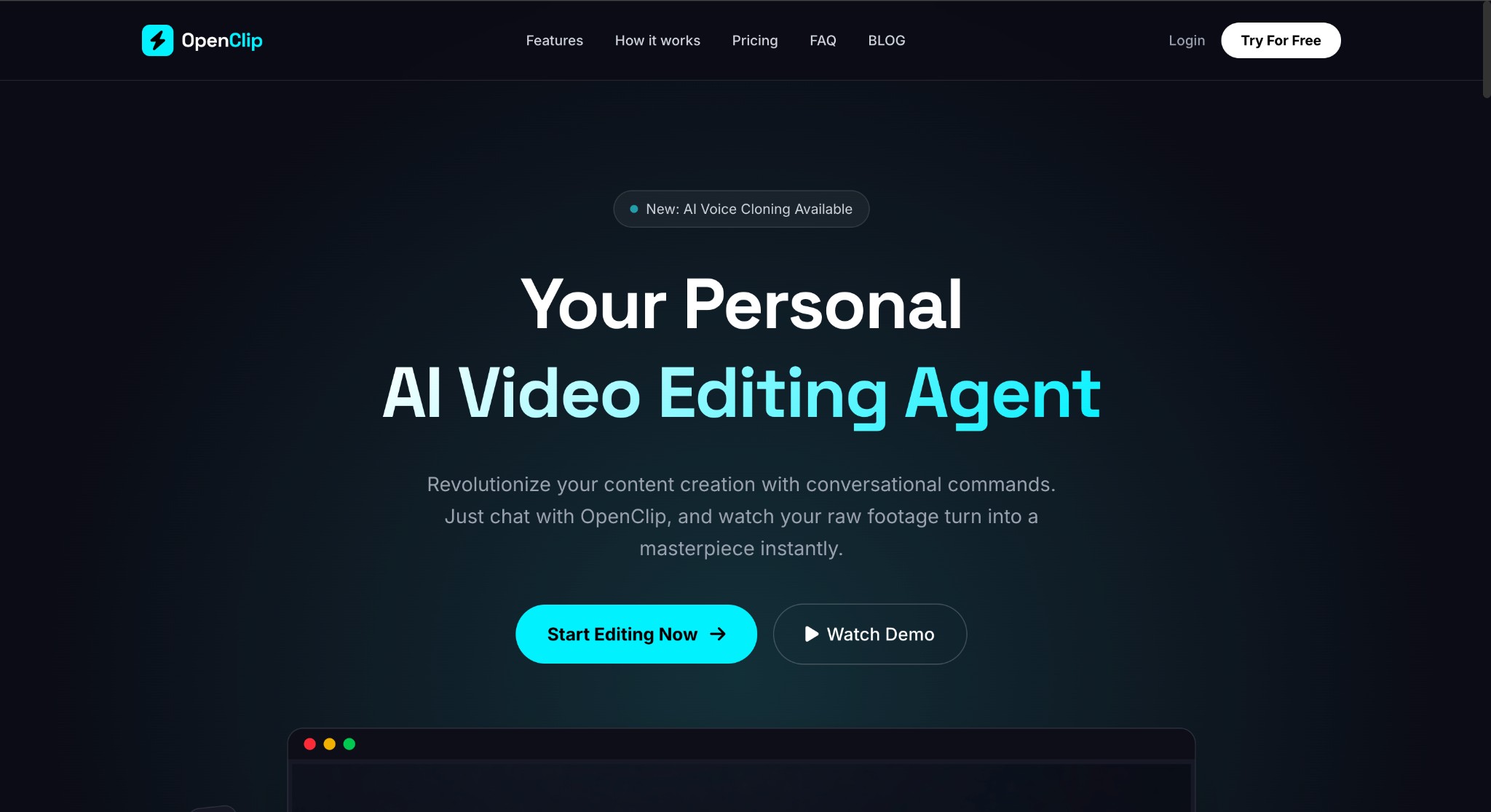
In the rapidly evolving landscape of digital content creation, efficiency and intuitive control are paramount. OpenClip emerges as a groundbreaking solution, positioning itself as a personal AI video editing agent designed to democratize professional video production. This innovative tool leverages advanced artificial intelligence to transform the often complex and time-consuming process of video editing into a seamless, conversational experience, making it one of the top AI video tools available for modern creators.
The Power of Conversational Editing
OpenClip redefines video editing by harnessing the power of natural language commands. Instead of navigating intricate timelines and toolbars, users can simply chat with OpenClip, issuing instructions like "cut out the silent parts," "add a title card here," or "make this section more dynamic." This conversational approach transforms raw footage into polished, professional videos through simple chat instructions. The core concept of a "personal AI video editing agent" means that OpenClip acts as an intelligent assistant, understanding user intent and executing complex editing tasks with remarkable accuracy. This significantly lowers the barrier to entry, allowing individuals with no prior editing experience to achieve professional-looking results.
Automating the Tedious Tasks
The true strength of OpenClip lies in its ability to automate the most tedious and time-consuming aspects of video editing. A detailed look at its features reveals automatic silence removal, which intelligently identifies and eliminates dead air, ensuring a more engaging viewer experience. Simultaneously, OpenClip offers automatic caption generation, accurately transcribing dialogue and creating subtitles that enhance accessibility and watchability. Beyond these foundational elements, the AI can insert background music, intelligently syncing it with the video's pacing, and apply smart transitions that enhance visual flow. This automation allows creators to focus on their message and creativity, rather than getting bogged down in technicalities.
Seamless Integration for Modern Creators
OpenClip is meticulously crafted to cater to the needs of today's content creators, including YouTubers, vloggers, and social media influencers. Its intuitive interface and powerful AI capabilities enable multi-round revisions with unparalleled ease, fostering a dynamic creative iteration process. Users can experiment with different edits, receive instant feedback, and refine their videos without the usual frustration. OpenClip is not just another editing software; it's positioned as an ultimate content creation tool and a true "creation artifact," empowering individuals to produce high-quality videos efficiently and effectively, solidifying its place among the top AI video tools for streamlined workflows.
Beyond the Basics: Key Considerations for Choosing Your AI Video Tool
When evaluating top AI video tools, moving beyond initial feature lists is crucial for making an informed decision. The best tools not only simplify creation but also integrate seamlessly into your workflow and align with your ethical standards. This requires a deeper look into their technical prowess, user-friendliness, and commitment to responsible AI practices.
Technical Capabilities and Reliability
The true strength of an AI video tool lies in its underlying technology. Consider the accuracy of AI features like automatic caption generation or the quality of AI-driven transitions. Processing speed and rendering times directly impact your efficiency, especially for larger projects. Furthermore, assess how well the tool integrates with existing workflows and file formats to avoid compatibility headaches. Understanding the underlying AI models powering these tools can give insight into their sophistication and potential for nuanced video manipulation.
User Experience and Learning Curve
A powerful tool is only effective if it's usable. While feature-rich options can be tempting, an intuitive interface is paramount for a smooth user journey. For creators with limited technical background, 'zero-editing-skill' tools offer broader accessibility, democratizing video production. The availability of comprehensive tutorials, robust support, and active community resources can significantly reduce the learning curve and provide ongoing assistance. Ultimately, the best AI video tools prioritize a smooth and efficient user journey from import to export.
Security, Privacy, and Ethical AI Use
As AI video tools become more integrated into content creation, understanding their policies around data handling and privacy is vital. Clarify ownership of generated content to ensure you retain rights. Be aware of potential biases in AI algorithms and how developers are working to mitigate them, ensuring fair and representative outputs. Embracing the responsible use of AI in content creation means understanding the ethical implications and utilizing these powerful tools with integrity.
FAQ (Frequently Asked Questions)
Q1: What are the primary benefits of using AI video tools for content creation in 2025?
A1: AI video tools in 2025 offer significant benefits, including drastically reduced editing time through automation of tasks like silence removal and captioning, increased accessibility for users with limited technical skills, enhanced creativity with AI-driven generation and effects, and improved efficiency for repurposing content across different platforms. They democratize professional video production, making high-quality output achievable for a wider range of creators.
Q2: Can AI video tools truly replace human video editors?
A2: While AI video tools are incredibly powerful for automating many editing tasks and enhancing efficiency, they are unlikely to completely replace human video editors in the near future. Human editors bring nuanced creative judgment, storytelling intuition, and the ability to grasp complex artistic direction that AI currently cannot replicate. AI tools are best viewed as powerful assistants that augment, rather than substitute, human creativity and expertise.
Q3: What types of content are best suited for AI video tools?
A3: AI video tools are excellent for a wide range of content, including vlogs, social media clips, explainer videos, tutorials, and marketing content where efficiency and rapid turnaround are key. They are particularly beneficial for content that requires a lot of dialogue editing, automatic captioning, or quick repurposing into shorter formats. More experimental or highly artistic projects might still benefit from traditional editing methods, but AI is rapidly expanding its capabilities.
Q4: How do I choose the right AI video tool for my needs?
A4: To choose the right AI video tool, consider your specific content creation goals, your current skill level, and your budget. Look for tools that excel in the features most important to you (e.g., text-to-video generation, automatic editing, collaboration features). Prioritize user-friendly interfaces, reliable performance, and strong customer support. Reading reviews and trying out free trials can help you make an informed decision.
Conclusion
The landscape of content creation is undergoing a profound transformation, and the top AI video tools for 2025 are at the forefront of this revolution. As we've explored, these intelligent platforms, exemplified by innovators like OpenClip, are democratizing video production, making sophisticated editing and generation accessible through intuitive, conversational interfaces. The power they wield in automating complex tasks liberates creators from tedious processes, allowing them to channel their focus towards the heart of their craft: storytelling.
Embracing these cutting-edge top AI video tools is no longer just a competitive advantage, but a necessity for creators aiming to thrive in the dynamic digital realm. They offer unparalleled efficiency, enabling faster turnaround times and the ability to experiment with creative concepts previously out of reach. By integrating these tools into your workflow, you can significantly elevate the polish and impact of your video content, fostering deeper connections with your audience. Start exploring and integrating these AI-powered solutions today to unlock your creative potential and shape the next wave of compelling visual narratives.